E-mail: info@ificprep.ca
Scenario-Based IFIC Practice

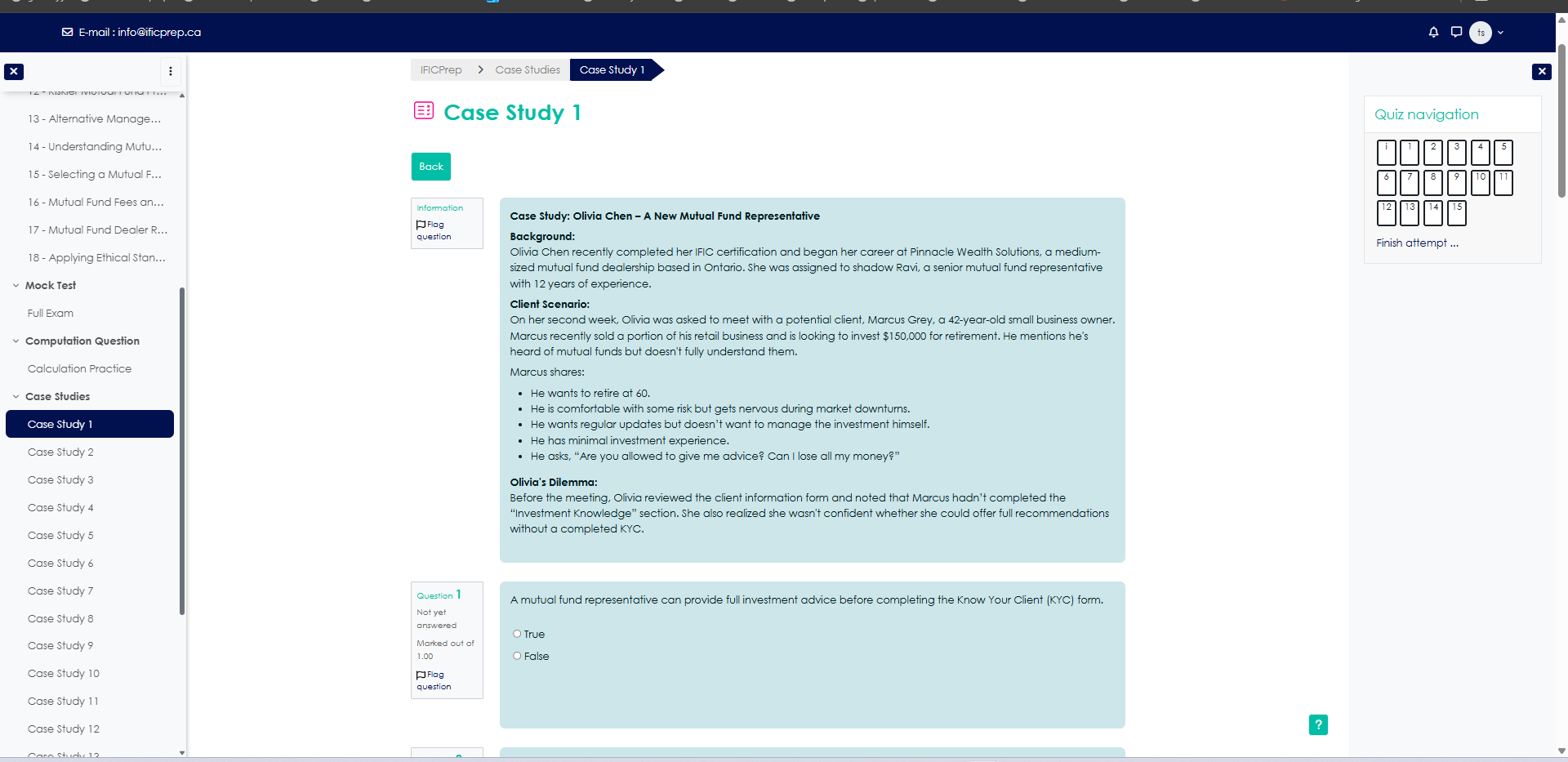
IFIC Case Studies: Practise Applying Concepts to Real Scenarios

Knowing a definition is useful. Knowing how to apply it when an investor, objective, product and risk profile are presented together is a different skill. IFICprep case studies are designed to help you practise that application.

Try the Free Sample Test Access IFICprep

Why case studies matter for IFIC exam preparation

Financial concepts rarely exist in isolation. A scenario can combine an investor's age, objectives, time horizon, risk tolerance, liquidity needs and financial circumstances. Your job is to decide which facts matter and how the underlying concepts apply.

1

Connect Multiple Concepts

Work with situations where several pieces of information must be considered together rather than tested separately.

2

Identify Relevant Facts

Learn to distinguish important investor or product details from information that may be less relevant to the question.

3

Practise Better Reasoning

Use the facts in a scenario to eliminate weaker alternatives and determine which answer best fits the situation.

What can IFIC case-study questions test?

Scenario questions can bring together different areas of the Investment Funds in Canada material and require you to apply them rather than simply recall a sentence from your notes.

Investor objectives and risk tolerance
Investment time horizon and liquidity needs
Know-your-client and suitability considerations
Investment product characteristics
Risk and return trade-offs
Mutual fund-related concepts
Registered plan and tax-related considerations
Financial calculations within a scenario

Example of scenario-based thinking

A strong case-study question makes you use the information provided, not simply choose the investment with the most attractive headline.

Illustrative IFIC-style scenario

Terry is investing money that he expects to use for a home purchase in approximately two years. He is uncomfortable with significant fluctuations in value and wants reasonable access to the funds.

Which factor should receive the greatest attention when evaluating an appropriate investment approach?

A. Selecting the investment with the highest historical return
B. Focusing only on Terry's age
C. Considering his short time horizon, liquidity needs and risk tolerance
D. Selecting the investment with the highest equity exposure

Answer: C. The scenario gives several relevant investor factors. The appropriate analysis should take the short investment horizon, need for access to funds and discomfort with large fluctuations into account rather than focusing only on potential return.

How to approach an IFIC case study

1. Read the Scenario Identify the investor, financial situation and investment objective before looking for the answer.
2. Extract Key Facts Pay attention to details such as time horizon, risk tolerance, liquidity needs, financial circumstances and objectives.
3. Identify the Concept Determine which IFIC concept the question is actually testing before evaluating the answer choices.
4. Eliminate Weak Answers Remove alternatives that ignore important facts, rely on only one consideration or conflict with the scenario.
5. Review the Explanation Understand why the correct answer fits the facts and why the other choices are weaker.

Move from memorizing facts to applying knowledge

Chapter study gives you the underlying knowledge. Case studies help test whether you can recognize which parts of that knowledge apply when several facts are presented together.

IFICprep combines case-study practice with chapter quizzes, concept review, calculation questions, flash cards and mock tests so you can practise both individual concepts and broader application.

Practise IFIC Concepts in Realistic Scenarios

Build your ability to analyse investor situations, identify the relevant concepts and choose the strongest answer with structured case-study practice.

Try the Free Sample Test Get 6-Month Access – $99