Chapterwise Mastery Quizzes
Work through focused questions chapter by chapter so you can identify weak concepts while the material is still fresh. Questions are designed to reinforce understanding, distinctions, rules and practical application rather than simply reward memorization.

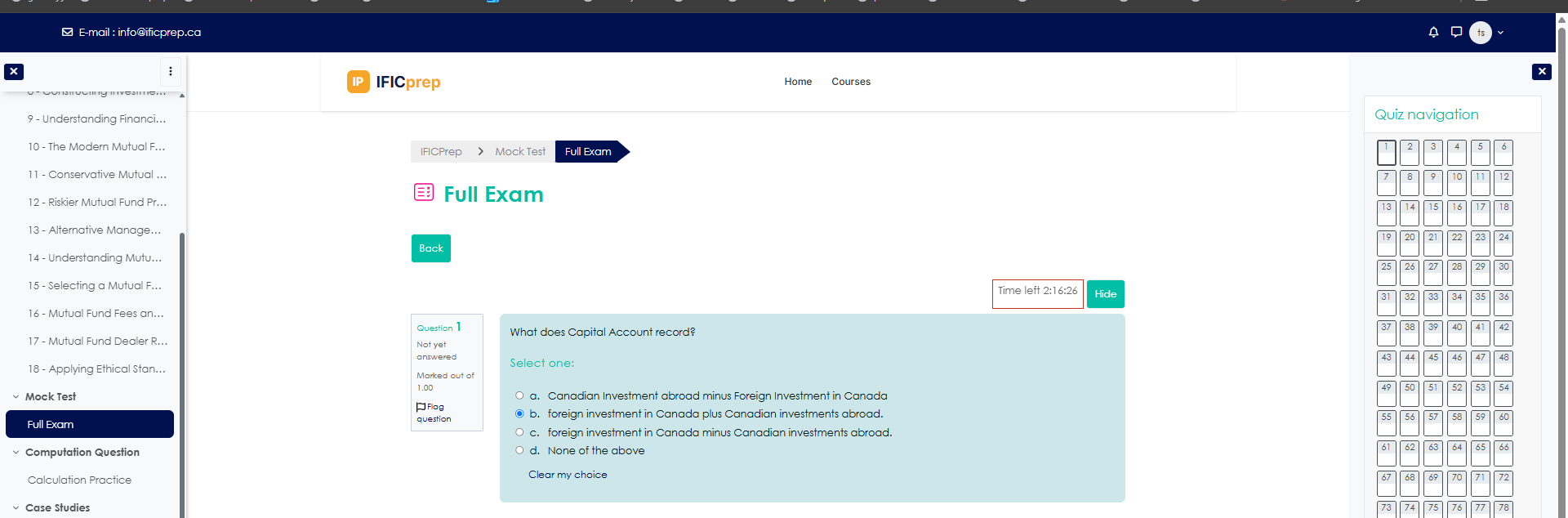
Full Mock Exam
Bring the chapters together in a timed, exam-style environment. The mock exam helps you practise pacing, switching between topics and retrieving knowledge without chapter cues.

Calculation Practice
Practise the numerical skills separately so formulas and calculation steps become familiar. The system provides feedback showing the relevant formula and correct result.

Scenario Case Studies
Apply multiple concepts inside realistic client and representative situations. Case studies move learning beyond isolated facts and ask you to recognize what matters when several pieces of information appear together.

Mastery Cards
Use quick flashcard-style retrieval to revisit important terms, rules, distinctions and concepts. Try to answer before turning the card rather than simply reading both sides.

Concept Vault
Use the searchable Concept Vault as a fast reference when a term or idea needs clarification. It gives you a central place to revisit important course terminology while working through practice activities.

The learning science behind the approach
IFICprep's structure reflects established findings in learning science. The research does not prove that any particular commercial prep course guarantees an exam result, but it does support the learning techniques used throughout this study system.
- Practice testing / retrieval practice: Dunlosky et al. (2013) rated practice testing and distributed practice as high-utility learning techniques.
- Retrieval improves long-term learning: Roediger & Karpicke (2006) found that testing can produce stronger delayed retention than repeated studying.
- Active retrieval with feedback: Karpicke & Roediger (2008) showed the importance of repeated retrieval for learning.
Research references: Dunlosky, J. et al. (2013), Psychological Science in the Public Interest, 14(1), 4–58. Roediger, H. L. III & Karpicke, J. D. (2006), Psychological Science, 17(3), 249–255. Karpicke, J. D. & Roediger, H. L. III (2008), Science, 319(5865), 966–968.